With
the Olympics going on but a few miles away from me to the north and the Proms to the west I though some
musical offering was in order especially as there was once in the
distance past Olympic medalists for Art competitions - more on
that here.

Debussy: Nocturnes - No. 2 Fêtes
Royal Albert Hall Orchestra cond. by Landon Ronald
HMV D 1000
[Cc 5863-III & Cc5684-II]
Recorded Tuesday, 10th March 1925
One Flac file, HERE at Mediafire. [about 16Mb]
One of the last acoustic orchestral recordings made by HMV the Debussy recording got decent reviews in its day, but I can't see the disc
having been reissued on LP or CD.
(Alec Robertson 'N.P.' The Gramophone, July 1925 ) 'Debussy's
Three Nocturnes (Nuages - Fêtes -
Sirines), composed in 1899, were
played by the Queen's Hall Orchestra with the composer conducting at
a concert of his works in February, 1909. Fêtes was
encored, together with the Prélude
à l'après-midi d'un faune it
is a most attractively scored work and has recorded exceptionally
well - as anyone might have prophesied - but-, as is so often the
case in Debussy's music, the composer is apt to repeat one rhythmic
figure ad nauseam;
a trick he probably learnt from the Russians. The gradual crescendo
to a climax that the march reaches comes out finely. There are many
delightful touches of colour, such as those afforded by the harps and
drums and the muted trumpets. The title of the movement sufficiently
indicates its programme, which may be supplemented by individual
fancy.'
(Discus in Musical Times, August 1925) 'Debussy's
'Fetes' (No. 2 of Three Nocturnes) makes a brilliant record. I know
of few, if any, better in regard to vivid tone, colouring, and
clarity of texture. It is a happy thought to record 'Fêtes ,'
for gramophonists appear to have little of this side of Debussy-a
side that records better (and wears better) than his more elusive (I
had almost said invertebrate) essays. The performance of 'Fêtes '
is by the Albert Hall Orchestra, conducted by Sir Landon Ronald.'
Landon
Ronald and the Royal Albert Hall Orchestra attempted to
record the first side of Fêtes in on the 8th
September 1922, the same day as the re-recording of Prélude
à l'après-midi d'un faune that was made to silently replaced the 1911 and 1916 version on HMV D 130. An attempt of making
a recording of the first side of Nuages was
made 4th September 1923 so there may have been and idea to
record the work complete. They where back in the Studio on the 10th March 1925
and this time managed the two side which were to be successfully issued in time for the July 1925 HMV Supplement. The recording was to last in the British catalogue until March 1930 even though the version of the Philadelphia Orchestra under Stokowski had been issued in September 1928 on HMV E 507. Considering the Acoustic 12 inch D 1000 cost 6s 6d and the 10 inch E 507
The name 'The Royal Albert Hall Orchestra' [RAHO] began life in 1915. - The orchestra was really the same as the New Symphony Orchestra that was formed by John Saunders, concertmaster; Eli Hudson, flutist, and Charles Draper, clarinet. Edward Howard-Jones conducted their first concert and in 1906 Thomas Beecham became conductor, Beecham fell out with the orchestra as many of its members did not want to tour in the north of England - this was due to poor wages and most of the orchestral members also playing in the London theater orchestras to make ends meet. In 1907 Landon Ronald conducted the orchestra and was appointed permanent conductor in 1909 with a series of concerts at the Queen's Hall which ran to 1914. When the orchestra started to play at the Royal Albert Hall it changed its name for these concerts to the RAHO and from 1920 the orchestra used the RAHO name wherever it performed. However C.B. Cochran, the general manager of the Royal Albert Hall put a stop to this and forced Landon Ronald to drop the RAHO name in 1929 when the orchestra became for a while known as the 'Orchestra formally known as the Royal Albert Hall Orchestra.' With the advent of the BBC and London Philharmonic Orchestras the RAHO was doomed and finally expired soon after Landon Ronald death in 1938.
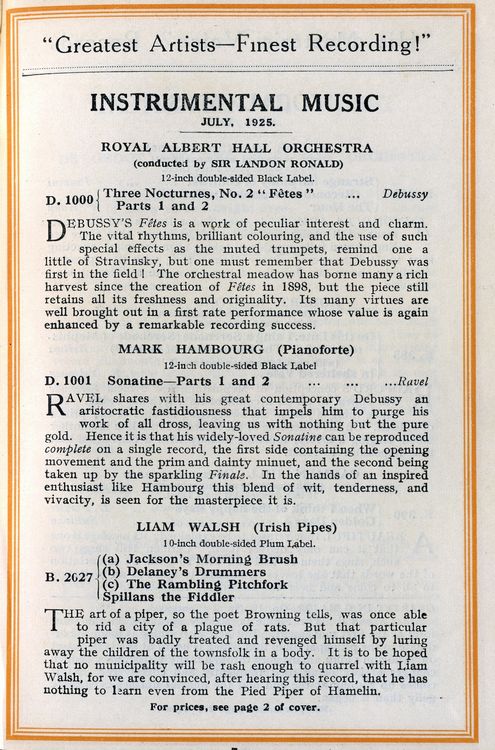 |
| Page from HMV Supplement July 1925 |
The name 'The Royal Albert Hall Orchestra' [RAHO] began life in 1915. - The orchestra was really the same as the New Symphony Orchestra that was formed by John Saunders, concertmaster; Eli Hudson, flutist, and Charles Draper, clarinet. Edward Howard-Jones conducted their first concert and in 1906 Thomas Beecham became conductor, Beecham fell out with the orchestra as many of its members did not want to tour in the north of England - this was due to poor wages and most of the orchestral members also playing in the London theater orchestras to make ends meet. In 1907 Landon Ronald conducted the orchestra and was appointed permanent conductor in 1909 with a series of concerts at the Queen's Hall which ran to 1914. When the orchestra started to play at the Royal Albert Hall it changed its name for these concerts to the RAHO and from 1920 the orchestra used the RAHO name wherever it performed. However C.B. Cochran, the general manager of the Royal Albert Hall put a stop to this and forced Landon Ronald to drop the RAHO name in 1929 when the orchestra became for a while known as the 'Orchestra formally known as the Royal Albert Hall Orchestra.' With the advent of the BBC and London Philharmonic Orchestras the RAHO was doomed and finally expired soon after Landon Ronald death in 1938.


