Friday, 8 June 2012

Acoustic organ music with a twist

Probably the first attempt at recording this famous Widor toccata and the Lemmens too for that matter, but what exactly are we listening to?


Charles-Marie Widor 
Symphony for Organ No. 5 in F minor, Op. 42, No. 1 -Toccata

Jaak Nikolaas Lemmens
March Tiomphale
[The beginning of this side is very badly worn] 

Frederick John Easthope Martin Organ

HMV C 461
[7000f & 6990f]
Recorded: Friday 17th January 1913

2 Flac file HERE & HERE Mediafire. [13Mb & 10Mb].

Organ music was all but impossible to record under the acoustic process, the bandwidth restriction gave very unsatisfactory results and it was not until the advent of electrical recording in 1925 that the organ became a reality for the gramophone enthusiast.

A few valiant early attempts were however made. On the 17th of January 1913 an 'English Pipe Organ' was either installed in the Hayes recording studioor the recording equipment was transported to the Aeolian Hall in New Bond Street. Fred Gaisberg was in charge of the recording session that day and he may also have enticed Easthope Martin to record. In all, seventeen titles on twenty-one 12" waxes and two 10" were cut from which fourteen were issued. Designated for double-sided issue on plum label records at 4s [20p] each, the first four of these records were issued in April 1913. I luckily have a copy of the original flyer that HMV produced that month, interestingly the organ on the front bears no comparison to what was actually recorded and the two 'unsolicited letters' quoted are possibly due to the forwarding of sample discs prior to formal issue.


Another two records were issued in 1914 but our record had to wait until July/August 1915 to see the light of day.  About a hundred 'new' double-sided records were published in one go and numbered roughly from C 400 to C 500. They seemed to have been an odd collection of previously available single-sided issues and unused masters issued in order to bolster up the main catalogue for 1916, this was published in October 1915 to be ahead of the Christmas market.

I have re-balanced these two sides as much as I dare and although a good amount of rumble is unfortunately still prevalent I hope you are impressed at how much of the low frequencies Fred Gaisberg managed to record. 

Easthope Martin pedalling a Pianola of the Grieg Concerto in 
1912 with Artur Nikisch and the London Symphony Orchestra
The organist for that day was Frederick John Easthope Martin (1882-1925). Born in Stourport, he studied piano, organ, harmony and studied composition with Samuel Coleridge Taylor, at Trinity College London and then joined the Aeolian Company in London as an organist, pianolist and demonstrator. He wrote a number of choral works, songs, piano pieces and chamber works but unfortunately contracted tuberculosis at quite an early age and died aged 42 at Hampstead in London. More information on Easthope Martin can be found Here and Here.

The above picture I think holds the clue to these records. What we hear is not simply Martin playing an organ but that this is an Aeolian pipe organ, and what we are hearing is Martin's interpretation of Aeolian Organ Roll numbers 466 [later renumbered to 51466] and 52. A modern transcription of this roll can be heard on Youtube Here. Having looked over the 1919 edition of the Aeolian Pipe-Organ - Catalog I see all the items recorded by Martin are included and one can only assume that Martin actually recorded most of these Aeolian Rolls in the first place. I have tabulated the roll numbers to the recording session below. 
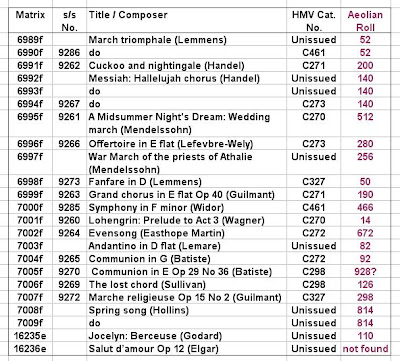


So what we appear to have on these recordings are Aeolian Rolls, probably recorded by Martin, who then brings them along to the HMV studio and then interprets his own previous recordings. I have not determined if the idea of recording was to promote the Aeolian Pipe-Organ or not. I don't think Aeolian could have been impressed by the sound of these primitive recordings and their name was not applied to the record labels. Gaisberg and indeed HMV maybe thought otherwise and went ahead and pressed the records for sale.

Martin returned to the studios later in 1913 to record a number of piano pieces under a pseudonym, these maybe Pianola recordings. One other facet to dwell on is that Nikisch was quite keen on the pianola and said 'I recognize it as one of the greatest inventions of the century.' Possibly some sort of introduction was facilitated by Martin to Fred Gaisberg and HMV to record orchestral music with Nikisch and the LSO in June 1913?  


Lastly, as I am getting more than a bit completest here, these are the descriptive notes transcribed from the Aeolian Catalog of 1919:-


466  WIDOR: Symphony No. 5 Toccata (Fifth Movement)
Following out the scheme of departing from the conventional order of symphonic movements the composer has chosen a Toccata for his final movement in this interesting symphony. This movement is, in several ways, the most attractive one of the entire work. Its whole course is stamped with buoyant swing—save the very close—and the theme of the Toccata is most spirited. Widor plunges precipitately into the announcement of this theme, voiced in the high treble; then there enters a bass melody that accents the theme woven by the treble. Gradually the bass assumes importance and volume, and finally it is thundered forth. The very close of this movement and of the symphony is a chorale-like version of the Toccata theme.


LEMMONS: March triomphale
With a curtly expressed theme—one of heroic character—this March auspiciously opens. It impresses the quality, hinted at in its title, upon the listener with the very beginning, and this idea is still carried out further by the crisp, sharply defined rhythm and almost defiant character of the succeeding section. The music rises now to a climax, and at the crest of this emotional wave there is trumpeted forth the first section of the March most brilliantly. After this the music grows gradually more subdued, and dies leisurely away, but the initial mood is fully restored by the jubilant chord upon which the work ends.

Sunday, 3 June 2012

In the Year of Jubilee

Well I thought I should do my bit for jingoism, being a staunch republican, the European variety that also equates to being a liberal, it is all a bit awkward.

Anyway music should be above such things....we hope...


Stanley Marchant (1883-1939) 
Te Deum laudamus. 
Composed for the King's Silver Jubilee Thanksgiving Service 
at St. Paul's Cathedral on Monday, 6th May 1935.

Choir of St Paul's Cathedral
Dr. Stanley Marchant Organ

HMV C 2752 
[2EA305-2 &2EA306-1]
Recorded: Monday, 6th May 1935

1 Flac  file HERE at Mediafire. [ 21Mb].

As this recording is taken from the actual Thanksgiving Ceremony, and first performance, I have not topped and tailed it. The running order is as follows if you want to skip to the music!

Lord's Prayer [0:02]
Te Deum, [0:58] 
Blessing [6:51]
God save the King [7:09]


Stanley Marchant is not a very familiar name and very little of his music has ever been recorded. I have taken the following biographical information from Grove, although this is more or less culled from the Musical Times obituary notice, extracts of which I have placed within square brackets:-

Stanley Marchant at the St Paul's organ
 'Sir Stanley Marchant, (1883-1949) English church musician, teacher and composer. He won a Goss Scholarship to the RAM, where he took prizes in composition and organ playing [the 'Battison Haynes' Prize for composition, and the 'Robert Newman' prize for organ-playing]. In 1899 he was appointed organist of Kemsing Parish Church. He moved to Christ Church, Newgate Street (1903), and then to St Peter's, Eaton Square (1913). He was made an FRCO (1902) and took the DMus at Oxford (1914). 

 'An association with St Paul's Cathedral had begun in 1903, with his appointment as second assistant [Not many years after this his devoted and loyal friend Sir George Martin, then organist at St Paul's, died, and Charles Macpherson, the sub-organist, took his place. Therefore in 1916 Marchant almost automatically became Sub-Organist and Master of the Choristers at St. Paul's. Then followed a tragedy in the early and lamented death of Macpherson. The Dean and Chapter realizing Marchant's exceptional intimacy with the music of the Cathedral appointed him, the 'Goss Scholar', to add his name to his eminent predecessors: Goss, Stainer, Martin and Macpherson. The grand traditions of St. Paul's were more than maintained by him, and the beautiful choral services were still a model for the world, not to mention those inspiring Lenten Services, when Bach's Passion Music (the St. Matthew or the St. John) was sung with such insight and moving reverence.] , and in 1927 he was made organist at a time when the building was partially closed for restoration.

 'He conducted the reopening ceremony (June 1930) and the thanksgiving service for the silver jubilee of King George V (6 May 1935), composing for each occasion a Te Deum. In 1914 he was appointed a professor at the RAM, where he became warden in 1934 and principal in 1936, relinquishing his post at St Paul's. He was then elected King Edward VII Professor of Music at London University (1937), knighted (1943) and made chairman of the council of the Royal School of Church Music (1947). In addition to anthems, canticles and other liturgical music he composed secular choral pieces, organ works and songs. Marchant's music, the finest of which was inspired by ceremonial occasions at St Paul's, is well crafted, though conservative in idiom, and shows the influence of Stanford and Parry. The choir library at St Paul's holds his complete choral works.'

[To his work as Principal of the R.A.M. he devoted great earnestness and the whole benefit of his long experience and many gifts. Of these gifts one of the most outstanding was his magnetism, which drew out the best from others. This was most apparent in his dealings with colleagues ; he placed implicit trust in them, and their trust in him never faltered, nor was ever misplaced. During this happy time many knotty problems were solved and 'concert pitch' was soon arrived at without friction or disturbance. It is very difficult to write of Sir Stanley and his life's work without exaggeration, for he had, in a quiet way, great powers of administration coupled with a most attractive personality. It was fine to see his wrath on occasions of injustice, or of conceited inefficiency-these brought his temper to the boiling point ! But, to my mind, his finest trait was his unyielding determination, and the heroic silence with which he bore for years the most crippling attacks of arthritis. Though it was a heavy handicap, no one ever heard him complain. However, all is not lost, for he has left his indelible mark on his Alma Mater which future generations will do well to try and emulate].

Probably this very 'conservatism' has done for him.

St Paul's Jubilee Service 6th May 1935

The Te Deum came at the closing of the Jubilee service held for George V and is the last of a set of three records that HMV issued of the event. HMV would have arranged with the BBC to record the service from their land-lines but before the BBC commentary was overlaid and broadcast to the Empire. In order to make a commercial issue the recording engineer first recorded the service on several recording machines which overlapped from one side to another. These would then be pressed and the sections that they wished to be issued were then dubbed on to new matrices.  This was all a bit tricky but by 1935 they had become quite adept at producing good results.

As can be seen above, a rather pretty 'sunburst' label was issued for the HMV Jubilee records. The company also produced a number of similar labelled issues - quite a few of which I seem to have, clearly succumbing to the royal influence -below are the pages from the 1938-39 HMV catalogue that list the rather odd celebratory material. 


My post title by the way comes from In the Year of Jubilee, a novel by George Gissing, well worth reading.


Saturday, 19 May 2012

The God of Scarborough


Ran off to Vienna for a week with my Mrs to stuff ourselves with cake, culture and music, thus have been a bit dilatory with fluff. I'm inflicting some more light music on you too, but promise some more 'serious' stuff next time

The 'God' here is not Haydn Wood but Alick Maclean another of those all but forgotten British conductors.

Alick Maclean, Scarborough 1932 - Pathe Films 

Haydn Wood:  Variations founded on Durandeau’s 
“If you want to know the time as a p’liceman”
[Variations on a Once Popular Tune]

New Queen's Hall Light Orchestra
cond. by Alick Maclean

HMV D 52 
[HO 4252 af, and HO 4253 af]
Recorded: Monday, 26th January 1920

1 Flac  file HERE at Mediafire. [about 23Mb].


Alick Maclean (b Eton, 20 July 1872; d London, 18 May 1936). English composer and conductor, father of organist Quentin Maclean. He was educated at Eton where his father, Charles Maclean, was director of music. In 1891 he resigned his army commission to resume musical studies. He won the Moody-Manners prize for the best one-act British opera in 1895 with Petruccio, an early example of verismo in England. His sister, writing under the pseudonym S(heridan) R(oss), was his librettist. Maclean was the musical director of Wyndham’s theatres (1899–1912), and subsequently conducted the Scarborough Spa Orchestra to great renown, until his death. In addition he conducted the Chappell (initially Ballad) Concerts from 1916 to 1923 and in the winter months of these years the New Queen’s Hall Light Orchestra. He conducted concert versions of his operas Quentin Durward and The Hunchback of Cremona and scenes from his oratorio The Annunciation in Scarborough in 1920. (Grove)

I strongly recommend watching the 1932 Pathe film of Maclean in all his glory performing in the specially built miniature seafront auditorium of Scarborough HERE. The illustration above is a still from this Pathe short.

If you can get hold of a copy, I recommend the reading of K.Young: Music’s Great Days in the Spas and Watering Places (London, 1968), which has a chapter on this conductor ‘Alick Maclean: the “God of Scarborough” ’, pp.78-107, and much else besides of this sadly diminished seaside tradition.


Haydn Wood


It is difficult to exactly date Haydn Wood's composition although I think it must be roughly of the same vintage as the recording. The score was not published until 1927 by which time it had acquired the new title ‘Variations on a once popular humorous song’. Haydn Wood conducted a performance of the piece at the Proms in 1926 under this latter title and this may have prompted the works publication.

The record names the work as ‘Variations founded on Durandeau’s “If you want to know the time as a p’liceman” - a somewhat cumbersome title that probably accounted for it being renamed. The record had a very short catalogue life. Issued by HMV in April 1920 it was deleted as soon as December 1921 although it did get into second and third stampers so initial sale may have been quite good. I don't recall actually seeing another copy of the disc and my pressing is not exactly in the first flush of youth having had various scuffs, scratches and a 2 inch crack inflicted on it. The label, as can be seen from the illustration, does not have the usual music copyright stamps affixed which points to the composition being played from an unpublished score, or maybe even from a manuscript fair copy.


The music critic W.R. Anderson spoke of the work after hearing it on the radio in his round up article for Musical Times published in January 1941 ‘Haydn Wood's Variations on a Once Popular Tune had long escaped me. I am glad to renew acquaintance with "If you want to know the time, ask a policeman" which makes just over ten minutes of ripe Robertian fun, with the authentic rolling gait of dignity, and an old-time opulence of frame that does not disable the constable from running to a horse-down, a fight or a fire. The piece would make a capital gramophone record.’ I don’t really have an idea what ‘Robertian fun’ means, does anyone?

This suggestion of a new recording was not taken up as far as I can see and the work languished until the Marco Polo label issued a series of CDs on British light music performed by the Slovak Radio Symphony Orchestra under Ernest Tomlinson. The original music hall song that the variations derive from was composed in 1889 by Augustus Durandeau with words by E.W. Rogers and originally performed by James Fawn.